Dolby Atmos 7.1.4
Modern classical music
in immersive audio
Music for immersive acoustic spaces.
The Mission
The advent of Dolby Atmos and advanced spatialization algorithms has fundamentally transformed how we perceive music and acoustic space. By placing the listener at the center of the experience rather than at a static receiving end, audio has become truly immersive.
This paradigm would have been deeply familiar to 17th-century baroque musicians performing in cathedrals—architectural spaces explicitly engineered for acoustic envelopment. Yet, while the philosophy of the listening environment is experiencing a renaissance, modern composition remains largely hesitant, still grappling with the structural implications of this newfound spatial freedom.
The Composer and the Philosophy
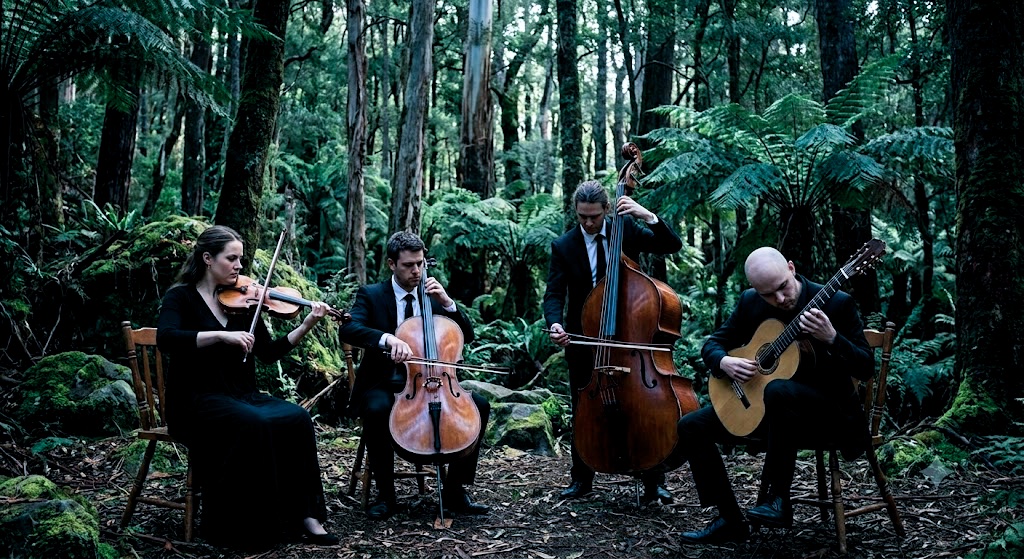
“Music is a higher revelation than all wisdom and philosophy.”Ludwig van Beethoven
“The music is not in the notes, but in the silence between them.”Claude Debussy
“In music, silence is more important than sound.”Miles Davis
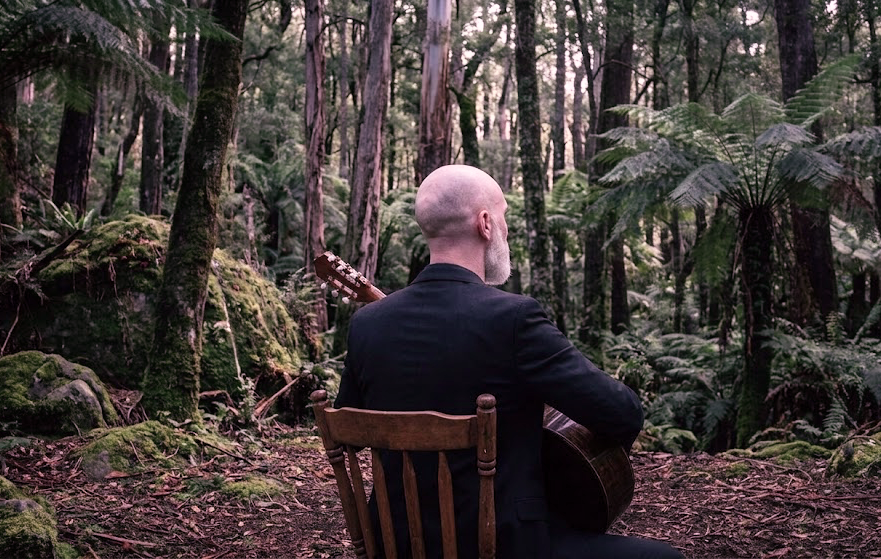
Classical guitar, Tasmania
The Composer
Deo is one of Australia’s most evocative original composers, with a body of work spanning twelve published albums, original film scores, and ambient installations created for civic spaces and therapeutic environments. His performances in Australia and internationally often bring classical solo guitar into dialogue with the spoken word. Among his most significant works is an original English translation and musical adaptation of Dante’s Purgatorio, which has been performed around the world since 2009.
At the heart of Deo’s work is the classical guitar—an instrument of profound intimacy. Through it, he has developed a distinctive tonal language that explores emotional territories seldom encountered in contemporary composition. His practice rests on the belief that a work’s emotional power resides as much in the raw, physical character of its sound as in the composition itself.
The pursuit of capturing the finest nuances of acoustic instruments has led Deo through more than twenty years of immersion in advanced sound engineering. For the past seven years, his attention has centred exclusively on spatial audio. Following a testing collaboration with Sony Japan on its 360 Reality Audio format, he embraced Dolby Atmos as his medium of choice—uniting the intimacy of acoustic sound with the seemingly boundless architecture of immersive space.
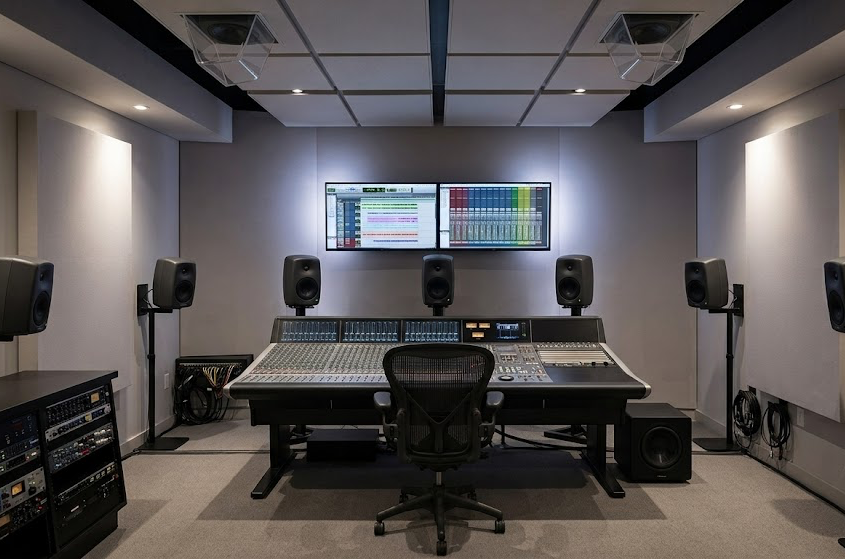
Atmos 7.1.4 studio
The Philosophy
I do not write music for a stereo image. I write it for a space. Whether I am working in Dolby Atmos 7.1.4 or another immersive format, the surround field is not something added after the music is finished. It is part of the composition from the beginning. Remove the spatial dimension and you have not simply reduced the piece; you have removed part of its structure. The room is not only where the music is played. It is where the music lives.
Because of this, I often hear intervals as movement before I hear them as pitch. A fourth is not only the distance between two notes. It is a sound travelling from one place to another. A melody becomes a path through the air. Composition, for me, is therefore partly a form of choreography: where does a sound begin, where is it going, and what happens to the listener as it moves?
Movement alone, however, does not create meaning. A coordinate says very little by itself. A sound placed behind the listener might suggest pursuit, memory, danger or something left in the past. Its meaning depends on the music around it, on what has already happened and on what changes when the sound moves.
Used carefully, space can work like a language. Nearness can suggest intimacy. Distance can suggest absence. Enclosure can create pressure or protection. An opening field can bring release. These things do not need to be explained in words; the listener feels them through the shape of the music. I therefore work with position, distance, height and movement as deliberately as I work with melody and harmony. Space stops being the container of the sound and becomes part of what the sound says.
That requires restraint. Movement without purpose is decoration, and constant movement soon loses its force. If everything moves, nothing matters. A meaningful spatial gesture needs a starting point, a change and a consequence.
A violin circling the listener simply because the technology allows it says very little. But imagine that the violin remains in its place within the ensemble for an entire work. Then, at the moment when its musical identity separates from the other instruments, it slowly leaves the front of the room, passes behind the listener and does not return. The movement now carries meaning because the spatial change and the musical change are the same event.
Spatial writing therefore demands the same judgement as orchestration. Not every sound can carry the main idea. Some elements belong at the centre; others support, surround or answer them. The most important gestures must also remain clear when the work is heard through headphones, in stereo or even in mono. The experience may become smaller, but the musical meaning should not disappear.
Creating these movements accurately requires more than instinct. Some trajectories must be shaped with careful numerical control: how quickly a sound moves, how it curves, how it rises, fades or returns. Certain movements are too exact to be drawn reliably by hand. They have to be calculated almost like an orbit.
Yet the source at the centre of this precision remains entirely physical. A classical guitar, carefully recorded in a real room, carries the touch of the player, the grain of the wood and the resonances of the space around it. The technology exists to preserve and extend that living presence, not to replace it.
In my spatial language, the instruments act as living figures and the surrounding field expresses their relationships. The guitar remains close, frontal and human. Height enters only when the music moves beyond personal utterance into contemplation. The rear field holds what remains outside the immediate exchange: memory, consequence, something from the past that has not finished sounding.
The precision lies in the engineering. The life remains in the wood, the string and the human hand.
I am also drawn to works that do not close themselves too neatly. The idea of the non finito—the unfinished work—has always interested me: a work may retain greater power when some of its forces remain active, when its edges stay open and it does not settle into a final answer simply because convention expects one.
A piece that resolves everything may not be complete. It may simply have stopped out of habit.
I would rather leave the field in motion. I would rather leave its edges alive.
Spatial Works in Dolby Atmos
These recordings are not stereo files. They carry the full Dolby Atmos object field: instruments positioned and moving in three-dimensional space around the listener, exactly as composed. To hear them as intended, open this page in Safari on a Mac, iPhone or iPad, listening through AirPods or another Atmos-capable output. Other browsers cannot decode this format and will show a note instead of a player.
Silentium
For full spatial rendering, enable Spatial Audio on your AirPods (Control Centre → volume → Spatialise Audio).
The Electronics and Poetry Years
These are only some of the 100 plus tracks, in no particular order, that I published at the end of the nineties and beginning of the 2000’s, just before leaving for Europe and falling in love with modern classical music. I have not published much new material since, due to my work in semiotics, frontier software and surround sound engineering. I will be coming back in 2027 with ‘Fides’ an album for classical guitar and string trio/quartet, recorded and performed in immersive audio.